







I have a virtual tour on my website and would like an audit.

I don't have a virtual tour yet, would love a demo to see how it works.

Choosing a university is rarely a simple decision. Prospective students are not only comparing programs, rankings, tuition, or admission requirements. They are also trying to understand what daily life would feel like in each environment: where they would study, how far they might walk between buildings, what the residence areas feel like, how accessible key facilities are, and whether the campus atmosphere matches their expectations.
For students who can visit every shortlisted university in person, these questions may be easier to answer. But many students and families cannot travel to multiple campuses because of distance, cost, time, visa limitations, mobility needs, or scheduling constraints. In those situations, traditional digital materials often become the main source of comparison. Photos, brochures, maps, and videos can help, but they rarely show how a campus functions as a connected environment.
This is where virtual campus tours play an important role. A well-structured virtual tour gives prospective students a way to explore multiple universities through immersive, interactive walkthroughs instead of relying only on curated visuals. It allows them to move through spaces, compare facilities, revisit important areas, and develop a clearer understanding of each institution before deciding where to apply, visit, or enroll.
Key Takeaways
- Virtual campus tours help students compare universities by giving them consistent, self-guided access to real campus spaces.
- Interactive walkthroughs improve spatial understanding by showing how classrooms, libraries, housing, student centers, and outdoor areas connect.
- Compared with photos or videos, virtual tours give users more control over what they explore and how deeply they evaluate each institution.
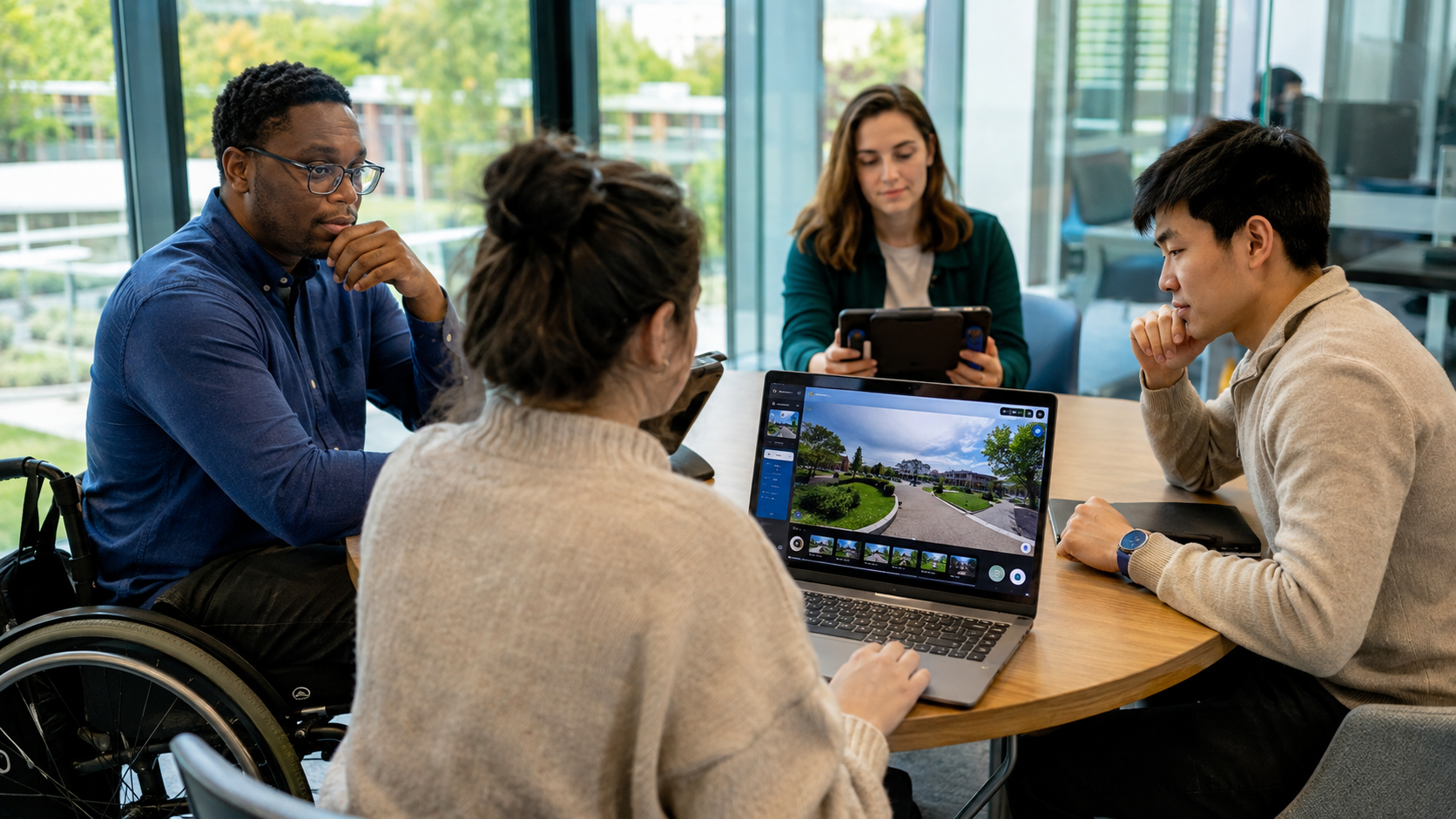
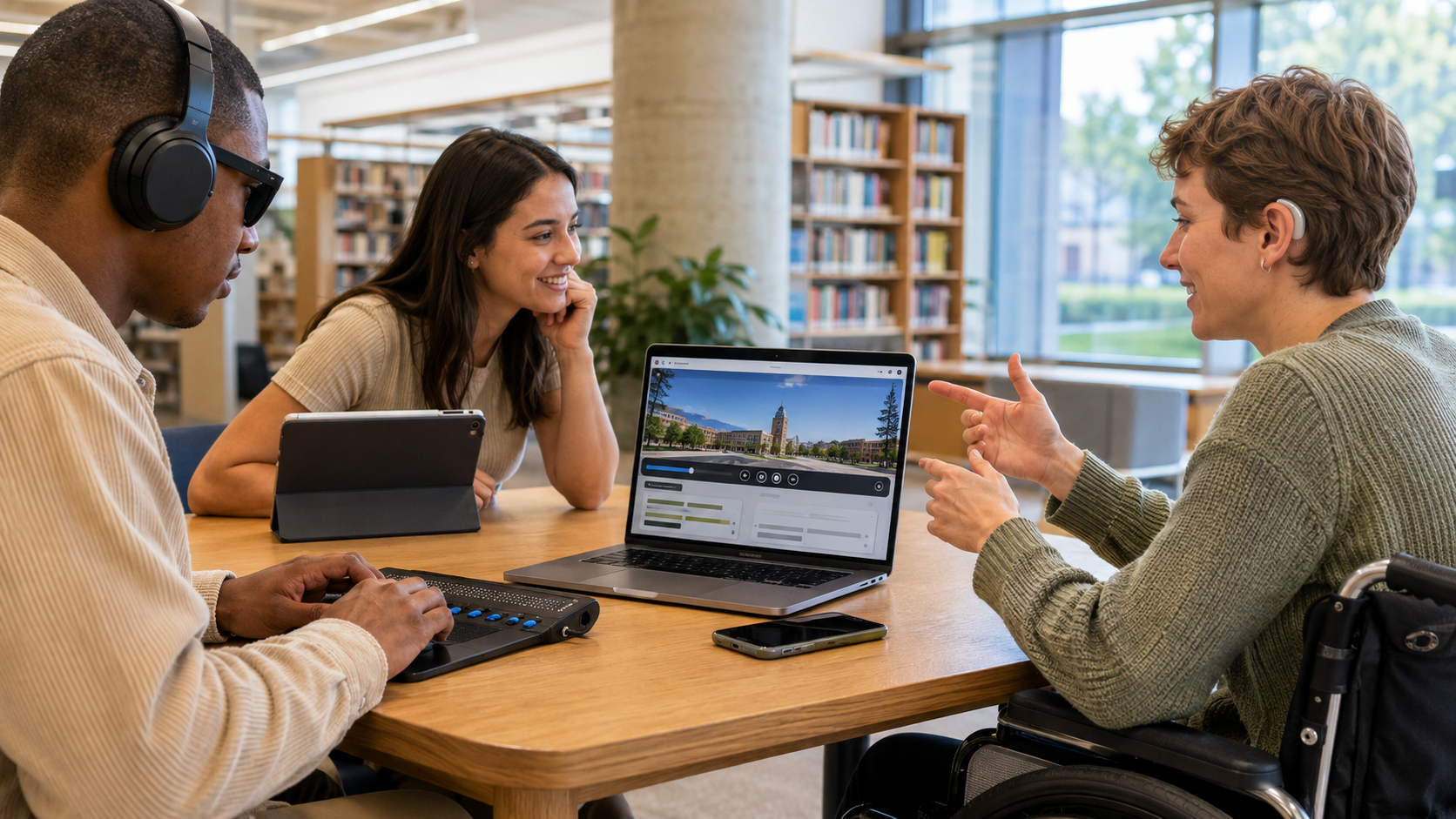
- Virtual tours support inclusion by giving remote, international, and mobility-limited students a clearer way to evaluate campuses.
- For universities, virtual tours create a more transparent digital experience that helps students make decisions based on understanding rather than guesswork.
Why This Topic Matters?
University comparison is not only an information problem. It is an experience problem.
A student may know that one university has strong academic programs, modern facilities, and active student life, but still struggle to imagine what it would be like to study there. Another university may have similar program offerings, yet the campus layout, housing experience, or learning environment may feel very different. These differences matter because students are choosing a place where they may spend several years of their lives.
Virtual tours matter because they reduce the distance between seeing a campus and understanding it. They support accessibility by allowing students to explore without needing to travel. They support inclusion by giving more students equal access to campus environments, regardless of geography or physical limitations. They support spatial understanding by showing how spaces relate to one another. And they support clarity by helping students compare institutions using the same type of experience.
Institutions use virtual tours not simply because they are modern or visually engaging. They use them because campus environments are complex. A university is not a single building or a collection of isolated images. It is a network of academic spaces, social spaces, support services, residence areas, outdoor pathways, and shared facilities. Students need to understand how these pieces work together.
When virtual campus tours are designed well, they help students move from “This looks interesting” to “I can see how I would experience this place.”
Virtual Campus Tours Create a More Equal Starting Point for Comparison
When students compare universities online, the quality of digital content can vary widely. One institution may have polished videos, another may rely on static images, and another may provide only maps or written descriptions. This inconsistency makes comparison difficult because students are not evaluating campuses through the same type of experience.
Virtual campus tours create a more equal starting point. Instead of asking students to piece together information from scattered content, they offer a structured environment where users can explore spaces directly. Students can move through academic buildings, residence areas, libraries, cafeterias, athletic facilities, outdoor spaces, and other key locations at their own pace.
This matters because comparison requires consistency. A student evaluating three universities can ask similar questions inside each tour:
How close are academic buildings to student housing?
What does the library feel like as a study environment?
Are the classrooms traditional, modern, collaborative, or specialized?
How easy is it to move between key campus zones?
What types of social or recreational spaces are visible?
Instead of comparing one university’s professional video against another university’s photo gallery, students can compare actual environments through interactive exploration.
Spatial Understanding Helps Students Compare Daily Life, Not Just Facilities
A common mistake in campus marketing is treating facilities as isolated selling points. A university may show a science lab, residence hall, student center, or lecture room, but students also need to understand how those spaces connect.
Spatial understanding is critical because students experience campuses through movement. Their day may involve walking from a residence hall to a dining area, from a lecture hall to a lab, from a library to a student support office, or from one side of campus to another. If students cannot understand proximity, scale, and flow, they cannot fully compare the practical experience of each university.
Virtual campus tours help by creating a navigable sense of layout. Through 360-degree views, connected walkthroughs, realistic paths, and floor-plan-style orientation where available, students can begin forming a mental map of the campus.
For example, a student comparing two universities may notice that both have strong academic facilities, but one campus feels more compact and easy to navigate while another feels larger and more spread out. Neither is automatically better. The value is that the student can understand the difference and decide which environment fits their preferences.
This is especially important for first-generation students, international applicants, students with mobility considerations, and families who want to understand the practical realities of campus life before making travel or enrollment decisions.
Interactive Navigation Supports Student-Led Evaluation
Photos and videos decide what the viewer sees. Virtual tours allow the student to decide what matters.
This shift from passive viewing to active exploration changes the comparison process. A prospective engineering student may spend more time exploring labs and project spaces. A student interested in campus life may focus on residence halls, dining areas, and recreation spaces. A parent may pay closer attention to safety, accessibility, building conditions, and support facilities. An international student may revisit housing, arrival points, and common areas multiple times to reduce uncertainty.
This user-led behavior is important because students do not all compare universities in the same way. Their priorities differ based on program, background, family expectations, budget, location, accessibility needs, and personal comfort.
A virtual campus tour respects that difference. It does not force every user through the same fixed sequence. It gives them control over where to go, what to inspect, and how long to stay in each space. That control leads to more meaningful comparison because students are evaluating based on their own decision criteria, not only the institution’s preferred highlights.
Contextual Information Helps Students Understand What They Are Seeing
A campus walkthrough becomes more useful when it explains the meaning of spaces, not just their appearance.
A student may enter a room virtually and see desks, screens, seating, or equipment. But without context, they may not know which programs use the room, whether it is a general classroom or specialized facility, how students interact there, or why the space matters. This is where interactive information layers add value.
Modern virtual tours can include clickable hotspots, embedded media, audio narration, labels, maps, or informational pop-ups. These elements help users interpret the environment while they explore it. For universities, this is particularly useful because many important campus spaces require explanation.
A lab may represent hands-on research.
A student center may reflect community life.
A library may support quiet study, collaboration, digital resources, and academic support.
A residence hall may communicate comfort, privacy, and proximity to student services.
When students compare multiple universities, this context helps them move beyond surface-level impressions. They are not just asking which campus looks better. They are asking which campus communicates its purpose more clearly and which environment feels easier to understand.
Virtual Campus Tours vs Photos: From Selected Angles to Continuous Understanding
Photos are useful, but they are selective by nature. They show a moment, an angle, and a framed impression. A strong photo can make a facility look appealing, but it cannot show how that facility connects to the rest of the campus. It also cannot show what is behind the viewer, how large the room feels, or how a student would move through the space.
When students compare universities through photos, they often compare presentation quality rather than experience quality. One university may have better lighting, better staging, or more updated imagery. Another may have equally strong facilities but weaker visuals. This can create an uneven and sometimes misleading comparison.
Virtual tours reduce that limitation by allowing students to look around freely. They can inspect the front, back, sides, pathways, entrances, and transitions. They can move from one area to another and build a more complete impression.
The impact is not just visual. It affects decision-making. Photos answer, “What does this place look like from this angle?” Virtual campus tours answer, “How does this place feel when I move through it?”
That difference is especially important when students are comparing universities they may not be able to visit in person.
Virtual Campus Tours vs Videos: From Guided Storytelling to Personal Exploration
Videos can be powerful because they provide rhythm, emotion, and storytelling. A good campus video can introduce the institution’s personality and highlight important themes. But videos are still fixed experiences. The institution controls the sequence, the pacing, and the viewpoint.
For comparison, this creates a limitation. A student may want to spend more time inside a residence hall, but the video may move on after five seconds. A parent may want to inspect accessibility routes, but the video may focus on scenery. A student comparing science facilities may want to revisit a lab several times, but the video may only show a brief clip.
Virtual campus tours change the relationship between the user and the content. Instead of watching a campus story, students explore the campus environment. They can pause, return, compare, and inspect based on their own questions.
This does not make videos irrelevant. Videos can still support emotion, student voices, and institutional storytelling. But for comparison, virtual tours provide something videos cannot: user control. And control is essential when students are making personal, high-stakes decisions.
Virtual Tours Help Families Compare Universities Together
University decisions are often shared decisions. Students may be the primary decision-makers, but parents, guardians, siblings, counselors, and advisors often influence the process. For families separated by geography or busy schedules, comparing campuses together can be difficult.
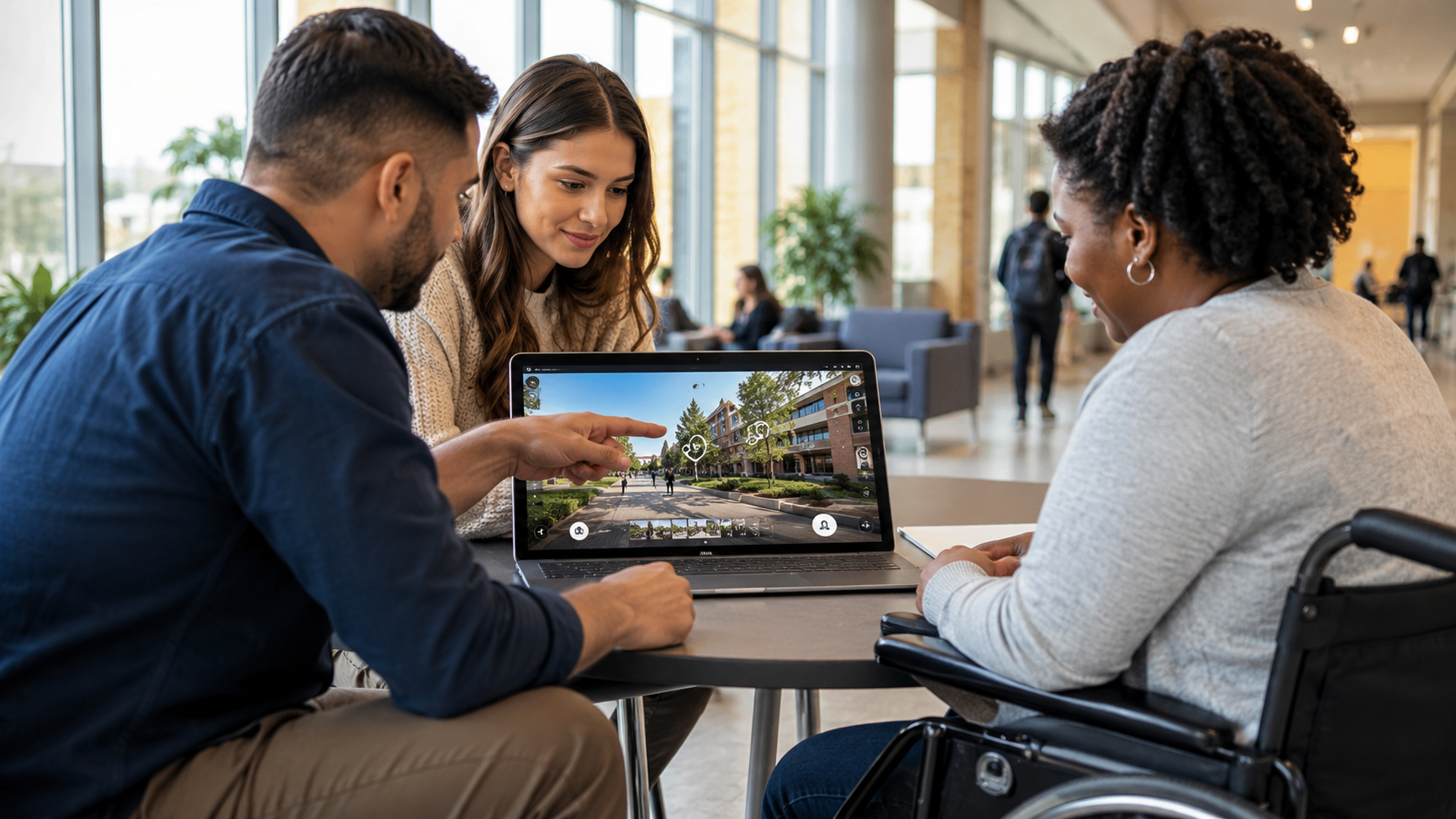
Virtual tours make shared evaluation easier. A student and parent can explore the same campus remotely, discuss what they see, revisit key facilities, and compare impressions. Families can look at residence areas, dining spaces, academic facilities, and campus layout without needing to coordinate immediate travel.
This supports better conversations. Instead of relying on vague statements like “the campus looks nice” or “the dorms seem okay,” families can discuss specific observations:
The library seems close to the academic buildings.
The residence area looks separate from the main classroom spaces.
The student center appears central to campus life.
The lab facilities seem easy to identify and understand.
These details create more grounded decision-making. They also reduce anxiety because families can see and evaluate the environment together.
Virtual Tours Support Remote, International, and Accessibility-Conscious Students
For remote and international students, comparing universities can be especially difficult. Travel may be expensive, time-consuming, or impossible before acceptance. Some students may also face visa limitations, health concerns, mobility needs, or family responsibilities that prevent in-person visits.
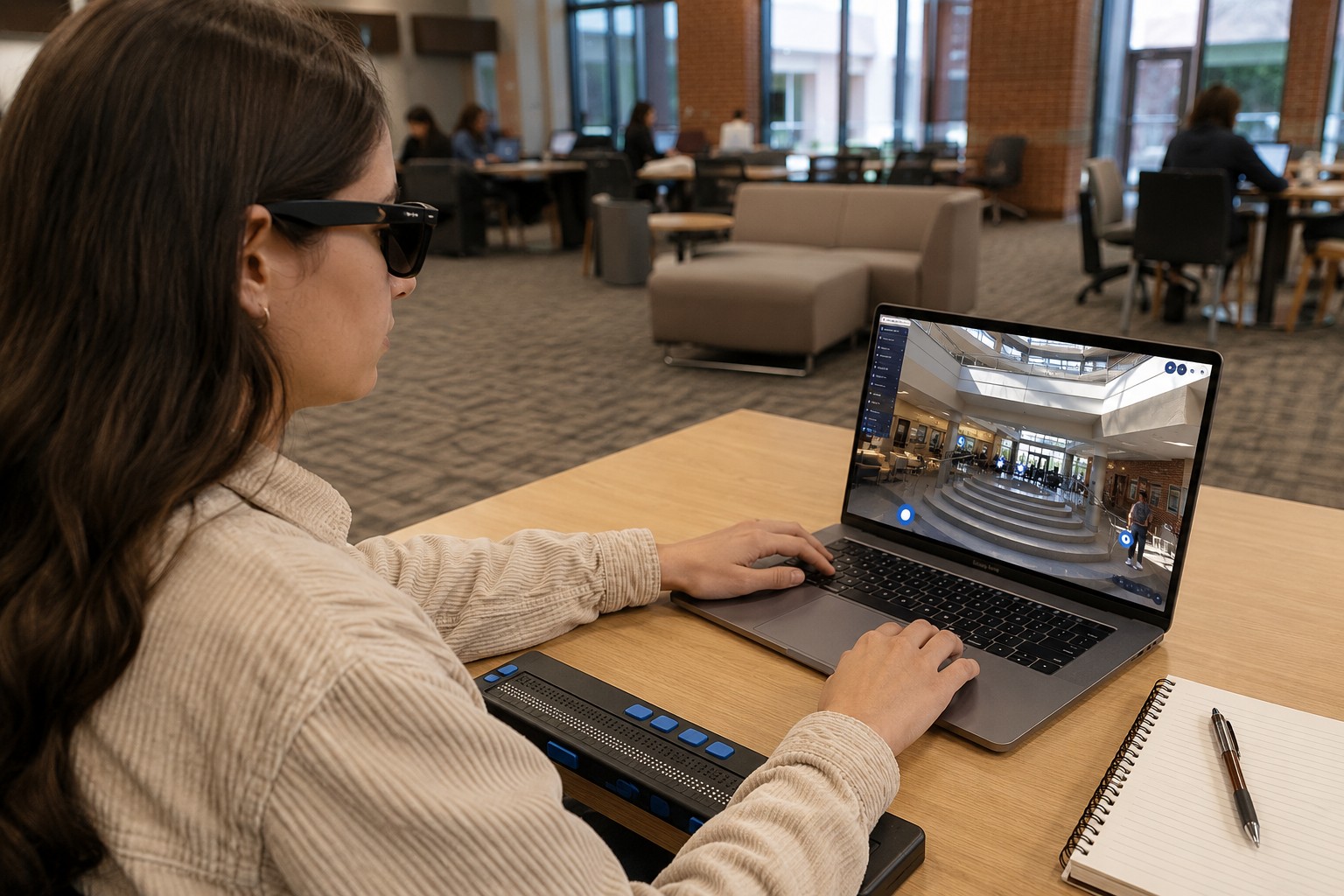
Virtual campus tours help reduce these barriers by making campus exploration available from anywhere. Students can access the experience on their own schedule, revisit spaces multiple times, and compare universities without needing to be physically present.
This is not only a convenience. It is an inclusion issue.
When campus exploration depends entirely on physical visits, students with more resources gain more information. Students who cannot travel must make decisions with less context. Virtual tours help close that information gap by giving more students access to the same visual and spatial understanding.
For institutions, this supports a more transparent admissions experience. It shows that the campus is not only available to those who can travel, but also to those who need remote access to make informed decisions.
For a deeper look at this topic, see How Universities Make Campus Experiences Accessible to Remote Students.
Virtual Tours Help Students Shortlist Universities More Efficiently
Most prospective students do not need to visit every university physically. They need to decide which universities are worth deeper engagement.
Virtual campus tours help with this early-stage filtering. A student may explore several institutions online and narrow the list based on environment, layout, facilities, accessibility, and overall fit. This can make later in-person visits more purposeful because the student already has a baseline understanding of each campus.
For example, a student comparing five universities may use virtual tours to identify two campuses that feel most aligned with their expectations. They may then prioritize those for applications, open houses, conversations with admissions teams, or physical visits.
This does not mean virtual tours replace in-person visits in every case. Instead, they improve the quality of the decision journey. They help students ask better questions, identify what matters, and avoid spending time or money on visits that may not be necessary.
FAQs
Virtual campus tours help students compare universities by giving them direct, interactive access to campus spaces. Instead of relying only on photos or descriptions, students can explore layouts, facilities, housing, academic buildings, and shared spaces in a more consistent and realistic way.
They are better for understanding space and layout. Photos can show selected views, but virtual tours allow students to move through environments, look around freely, and understand how spaces connect. Photos are useful for quick impressions, while virtual tours support deeper evaluation.
Not completely. Physical visits still offer direct sensory experience and personal interaction. However, virtual tours help students shortlist universities, reduce uncertainty, and compare campuses before deciding whether an in-person visit is necessary.
International students may not be able to visit campuses before applying or enrolling. Virtual tours give them access to academic spaces, housing, student areas, and campus layout from a distance, helping them make more informed decisions with less uncertainty.
Universities should include the spaces students genuinely need to evaluate: classrooms, labs, libraries, residence areas, dining spaces, student centers, outdoor paths, support services, and key transition areas. Contextual elements such as hotspots, labels, narration, and maps can also help students understand what each space is used for.
Final Thoughts
Virtual campus tours help prospective students compare universities by turning digital research into spatial understanding. They allow students to move beyond isolated visuals and begin evaluating how a campus actually works as an environment.
For schools, colleges, and universities, this matters because students are not only choosing an academic program. They are choosing a place to learn, live, connect, and grow. The clearer that environment becomes, the more confidently students can compare their options.
The long-term value of virtual tours lies in accessibility, trust, and transparency. They make campus exploration more inclusive for students who cannot visit easily. They help families make more informed comparisons. And they allow institutions to present their spaces in a way that is structured, realistic, and useful.
As university decision-making becomes increasingly digital, virtual campus tours will continue to play an important role—not as a replacement for human connection, but as a clearer bridge between interest and understanding.
I have a virtual tour on my website and would like an audit.
I don't have a virtual tour yet, would love a demo to see how it works.