







I have a virtual tour on my website and would like an audit.

I don't have a virtual tour yet, would love a demo to see how it works.

Choosing a school, college, or university is not just about reviewing academic programs. Students also want to understand what it would feel like to move through the campus, attend classes, use shared spaces, and imagine daily life in that environment.
Photos help, but they can only show selected moments. A library photo may show a bright reading area. A dorm photo may show a clean room. A courtyard photo may show a beautiful outdoor space. What those images usually cannot explain is how these places connect, how far they are from one another, how students might move through them, or how each space supports the broader campus experience.
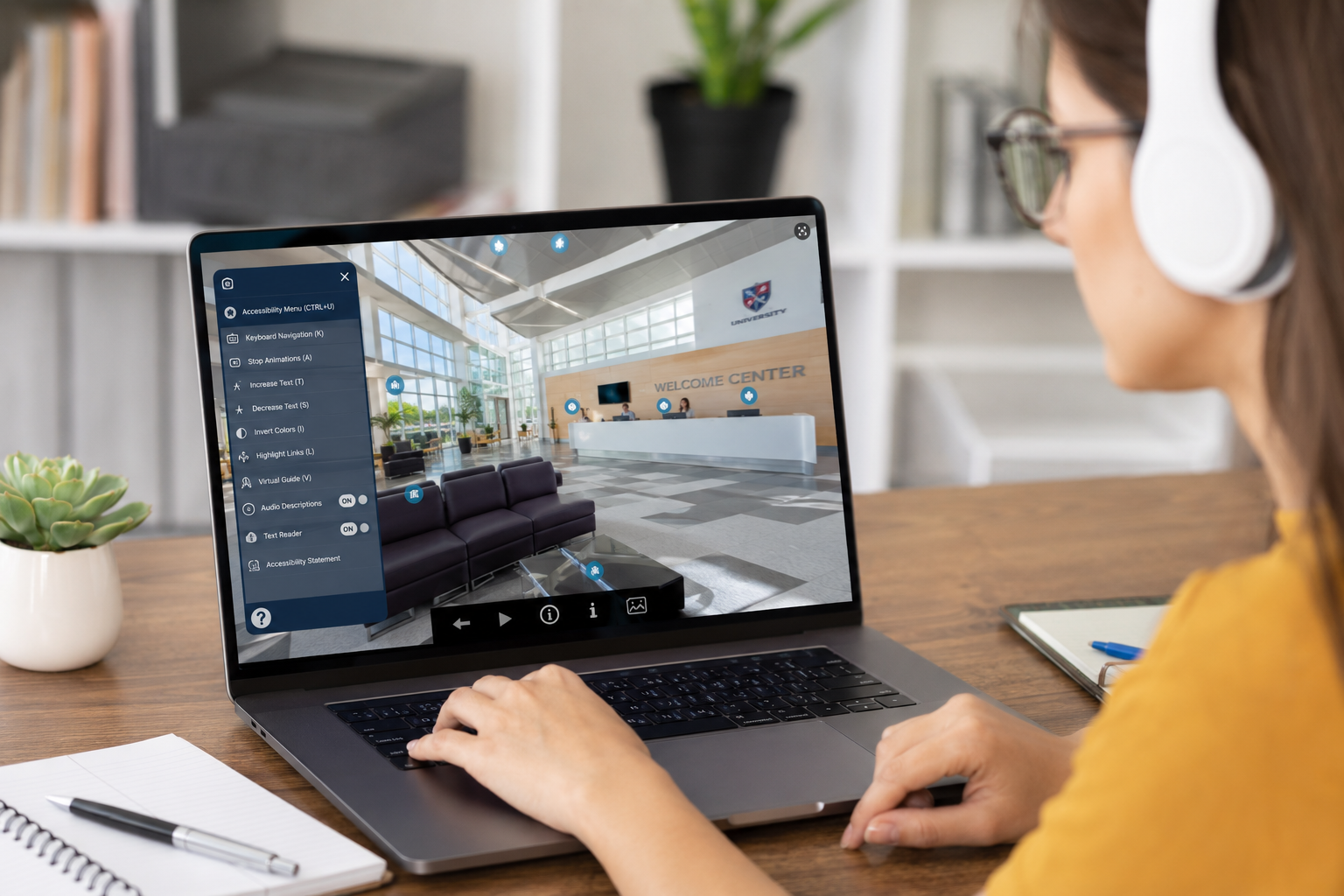
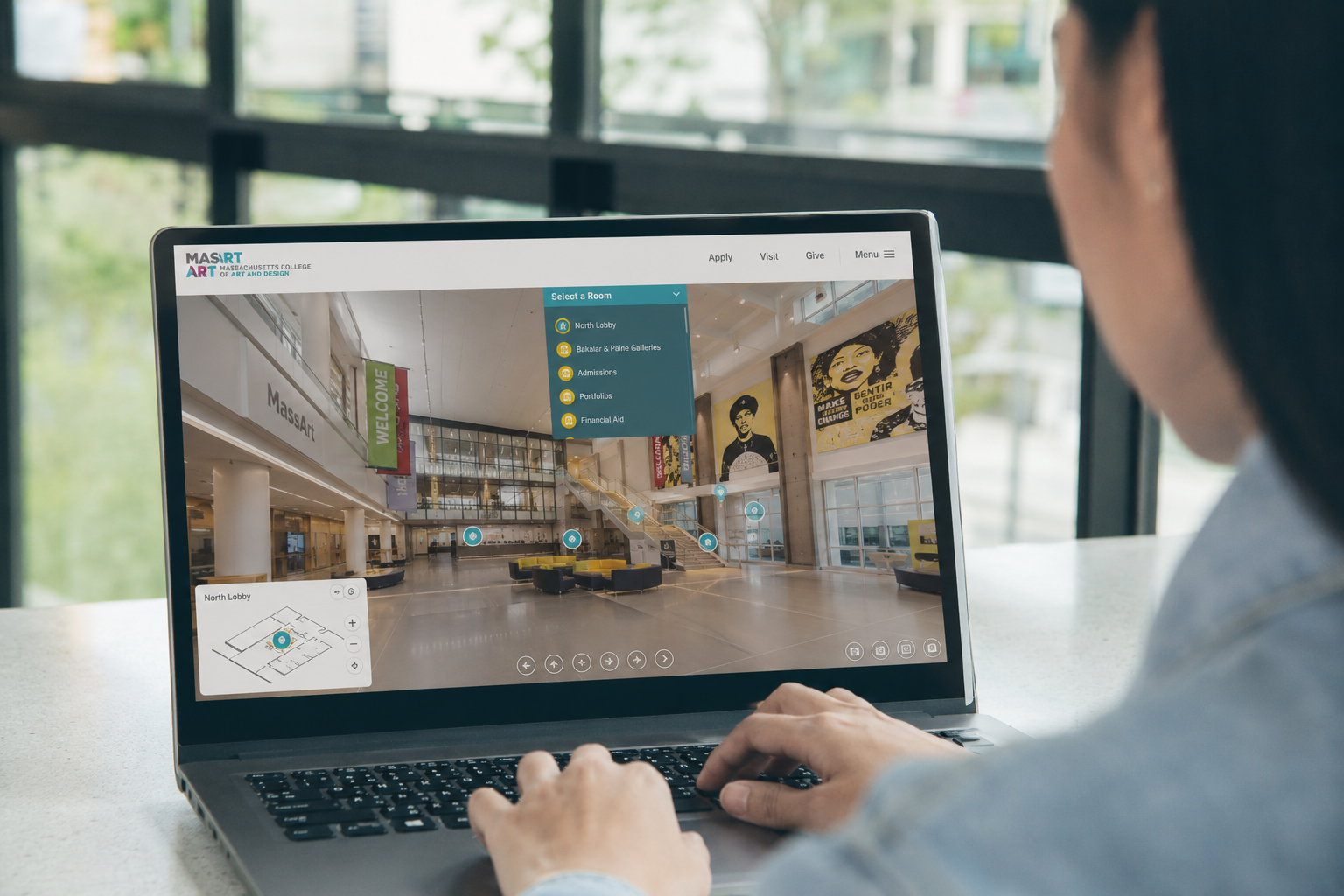
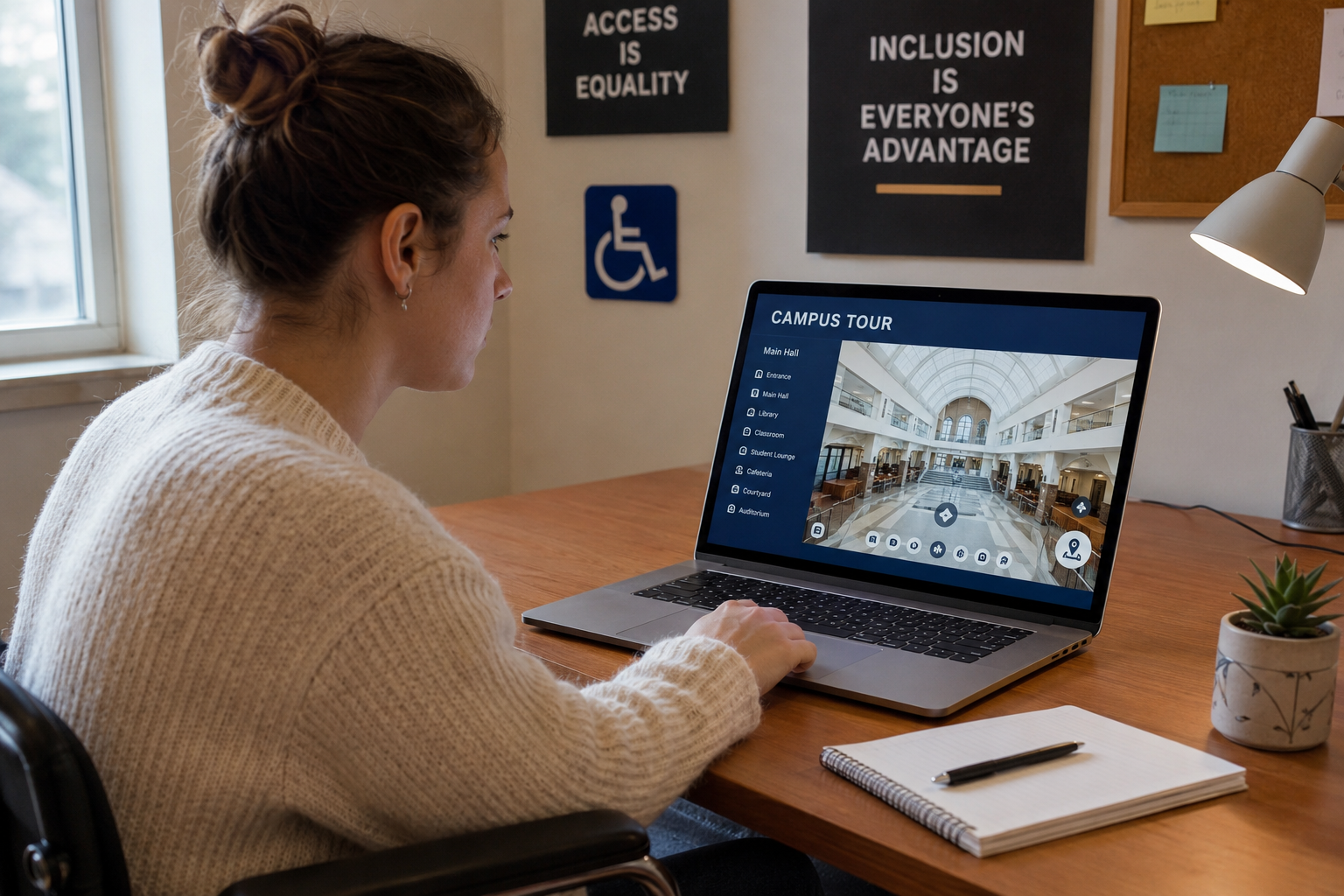
This is where a virtual campus tour becomes more valuable than a gallery of images. It allows prospective students, parents, remote applicants, and other stakeholders to explore a campus as a connected environment. Instead of looking at isolated visuals, they can navigate through academic buildings, housing areas, student facilities, outdoor spaces, and key campus touchpoints in a way that feels closer to an actual visit.
This blog explains what students can learn from a virtual tour that photos alone cannot show, and why that difference matters for schools, colleges, universities, and other educational institutions.
Key Takeaways
- A virtual campus tour helps students understand layout, scale, and movement in ways static photos cannot.
- Interactive walkthroughs allow users to explore spaces at their own pace instead of relying on curated image selections.
- Virtual tours provide context around how classrooms, labs, libraries, dorms, and shared spaces function in daily student life.
- Remote and international audiences benefit from more equal access to campus environments.
- For institutions, virtual tours support clarity, transparency, and more informed decision-making.
Why This Topic Matters?
A campus is not simply a collection of buildings. It is a living environment where academic, social, residential, and support spaces work together. For students who cannot visit in person, understanding that environment is difficult when the only available materials are photos, brochures, or short videos.
This matters because educational decisions are high-trust decisions. Students and families are evaluating comfort, safety, accessibility, academic fit, social fit, and long-term confidence. When digital content only shows polished highlights, it can leave important questions unanswered.
A virtual tour helps close that gap by giving users a clearer spatial understanding of the campus. They can see how spaces relate to one another, how movement flows from one area to the next, and how facilities support real student needs. This supports accessibility for remote audiences, inclusion for those who cannot easily travel, and transparency for institutions that want to present their spaces clearly.
Photos Show Appearance. Virtual Tours Show Spatial Understanding.
Photos are useful for first impressions. They can capture architecture, lighting, design, and atmosphere. But they are static by nature. A photo shows one angle from one position at one moment.
A virtual campus tour gives students something different: spatial continuity.
In a well-structured 360-degree virtual tour, students can move from one space to another and understand the relationship between them. They can begin at an entrance, continue into a lobby, enter a classroom, move toward a study area, and then explore a nearby common space. This creates a mental map.
That mental map is important because students often ask practical questions:
- How close are dorms to academic buildings?
- Is the library easy to reach?
- Do classrooms feel accessible?
- Are student spaces integrated into the campus or isolated?
- Does the campus feel compact, spread out, formal, open, or easy to navigate?
A photo cannot answer those questions well because it removes the space from its surroundings. A virtual tour keeps the surroundings intact.
Students Can Learn How a Campus Actually Flows
Campus flow is one of the most overlooked parts of digital campus research. A school may have excellent facilities, but students still need to understand how those facilities fit into daily movement.
For example, a science lab may look impressive in a photo. But in a virtual walkthrough, a student can see whether that lab is part of a larger academic building, near faculty offices, connected to classrooms, or positioned close to study areas. That context changes how the student understands the facility.
The same applies to libraries, cafeterias, residence halls, athletic spaces, performance spaces, and student centers. Students are not only evaluating what exists. They are evaluating how usable and accessible those spaces feel.
This is especially important for large campuses, multi-building institutions, and schools with specialized facilities. The ability to move through connected scenes helps students understand whether the campus feels intuitive or confusing. It also helps them prepare for what it might be like to arrive there in person.
Virtual Tours Show Scale More Clearly Than Photos
Scale is difficult to judge from a photo. A classroom may look spacious because of the camera angle. A hallway may look narrow because of lighting. A courtyard may appear larger or smaller depending on framing.
Virtual tours reduce some of this ambiguity because users can look around, rotate their view, zoom into details, and compare one area with another. They are not limited to the photographer’s chosen frame.
For students, scale affects comfort and expectations. A prospective student may want to know whether a lecture hall feels overwhelming or manageable. A parent may want to understand whether a residence hall common area feels open and visible. A student with mobility concerns may want to assess whether routes feel practical before visiting.
Photos can suggest these things, but virtual tours allow users to inspect them more independently.
This matters because confidence often comes from reducing surprises. When students have a clearer sense of scale before arriving, the campus feels less unfamiliar.
Interactive Walkthroughs Help Students Understand Function, Not Just Design
A photo can show what a room looks like. A virtual tour can help explain what the room is for.
This distinction is important in educational environments. Many campus spaces only become meaningful when their purpose is clear. A lab is not just a room with equipment. A media studio is not just a room with technology. A student lounge is not just furniture. A library is not only shelves and tables.
Interactive walkthroughs can provide context through hotspots, labels, embedded media, narration, maps, or guided pathways. These elements help students understand why a space matters and how it supports learning or campus life.
For example:
Academic Spaces
Students can explore classrooms, labs, studios, or lecture halls while learning how those spaces support instruction, collaboration, research, or hands-on learning.
Student Life Spaces
A lounge, cafeteria, recreation area, or courtyard can be understood as part of the social rhythm of the institution, not just as a visual feature.
Residential Spaces
Housing areas can be explored in relation to nearby facilities, helping students understand daily convenience, privacy, and community.
Support Spaces
Admissions offices, advising centers, libraries, and wellness-related areas can be placed within the broader campus journey so students understand where support exists.
This is where virtual tours become educational tools rather than just visual tools.
Students Can Explore Based on Their Own Priorities
Photos are usually selected by the institution. Videos are usually edited into a fixed sequence. Both formats guide attention in a controlled way.
A virtual tour gives users more control.
One student may spend most of their time exploring residence halls. Another may focus on labs. Another may care most about accessibility, parking, athletic spaces, or the distance between academic buildings and student facilities. A parent may revisit the same areas several times to better understand campus safety, layout, or convenience.
This user-led exploration matters because students do not all evaluate campuses the same way. Their questions differ based on program interest, family situation, location, mobility, budget, and personal comfort.
A virtual campus tour allows different users to extract different information from the same experience. That flexibility is difficult to achieve with photos alone.
Virtual Tours Help Remote and International Students Build Familiarity
For remote, out-of-state, or international students, visiting a campus may involve travel costs, visa limitations, scheduling issues, or family constraints. Some students may never be able to visit before applying or enrolling.
Photos can provide a basic impression, but they rarely create familiarity.
A virtual campus tour allows remote users to spend time inside the environment digitally. They can revisit spaces, share the tour with family members, compare areas, and return to specific locations when new questions arise.
This repeated exposure is valuable. Familiarity reduces uncertainty. When a student can explore the same campus more than once, the institution becomes less abstract. The student begins to understand not only what the campus looks like, but how it is organized.
For educational institutions, this supports inclusion. It gives distant audiences a more comparable way to evaluate the campus, even when physical attendance is not possible.
Virtual Tours vs Photos: The Impact on Decision-Making
The difference between photos and virtual tours is not only technical. It affects how students make decisions.
Photos tend to support impression-building. They answer questions like:
“What does this space look like?”
Virtual tours support evaluation. They answer deeper questions like:
“How would I move through this space?”
“Does this campus feel understandable?”
“Can I imagine myself here?”
“Do the facilities match my expectations?”
This shift matters because choosing an educational institution requires more than visual approval. Students need confidence. They need to understand whether the environment supports their academic goals, personal comfort, and daily routines.
Photos can inspire interest. Virtual tours can help turn interest into understanding.
Virtual Tours vs Videos: Why Control Matters
Videos are useful for storytelling. They can show people, movement, student voices, and institutional personality. But videos are linear. The viewer sees what the editor chooses, in the order it is presented.
Virtual tours are different because users control the path.
A student can pause in a classroom, return to a dorm area, skip to a library, or spend extra time exploring outdoor pathways. This self-guided behavior changes the experience from passive viewing to active investigation.
That control is especially useful during the consideration stage. When students are comparing multiple institutions, they often need to revisit specific details. A video may require scrubbing through a timeline. A virtual tour allows direct navigation.
Virtual Tours Can Reveal Campus Personality Without Overstating It
A good virtual tour does not need to exaggerate. Its strength is transparency.
When students can move through real spaces, they notice details that photos may not communicate: how formal or relaxed a building feels, whether common areas feel active or quiet, how open outdoor areas are, and whether facilities feel modern, traditional, compact, expansive, specialized, or community-oriented.
This helps institutions present character without relying on heavy promotional language.
For schools, colleges, and universities, that matters. Students are increasingly careful about polished marketing. They want a realistic sense of the environment. A virtual tour can support that by allowing the space itself to carry more of the message.
What Students Can Learn That Photos Cannot Fully Show
A virtual campus tour can help students understand:
Layout
They can see how buildings, entrances, pathways, and facilities connect.
Movement
They can understand what it may feel like to move from one part of campus to another.
Scale
They can judge the size and openness of spaces more clearly.
Function
They can learn how specific rooms and facilities support academic or student life.
Accessibility
They can examine routes, transitions, entrances, and spatial relationships before visiting.
Atmosphere
They can get a stronger sense of campus tone, structure, and environment.
Fit
They can begin to imagine whether the campus supports their expectations and comfort.
These are not small details. They are often the difference between seeing a campus and understanding it.
FAQs
Not completely. An in-person visit provides physical presence, live interaction, and real-time observation. A virtual tour is best understood as a strong decision-support tool. It helps students explore earlier, narrow options, prepare questions, and decide whether an in-person visit is necessary.
No. Schools, colleges, training centers, educational institutions, museums, organizations with physical spaces, and other campuses can benefit from interactive walkthroughs. Any institution that needs to help remote audiences understand a physical environment can use virtual tours effectively.
Virtual tours provide continuity, navigation, scale, and context. Photos show selected views, while virtual tours allow users to move through connected spaces and understand how the environment works.
Yes. Families often participate in educational decisions, especially when travel is difficult. A virtual tour allows parents and guardians to explore the campus remotely, understand facilities, and discuss options with the student using a shared visual reference.
No. A useful virtual tour should be clear, accurate, and representative. Highlighting important spaces is appropriate, but the experience should help users build realistic expectations, not only showcase polished visuals.
Final Thoughts
Photos will always have a place in campus communication. They are simple, immediate, and useful for visual storytelling. But when students need to understand a school, college, or university as a real environment, photos are limited.
A virtual campus tour adds the missing layer: experience.
It allows students to move, explore, compare, revisit, and understand. It helps remote audiences access spaces they may not be able to visit physically. It gives families clearer context. It supports students who need to evaluate layout, accessibility, scale, and daily use before making a decision.
For educational institutions, the long-term value is not only better presentation. It is greater transparency. A campus that can be explored openly becomes easier to trust. A space that can be understood from a distance becomes more accessible. And a student who can imagine themselves within that environment is better prepared to make a confident, informed choice.
Virtual tours are not just a replacement for photos. They are a more complete way to help people understand place.
I have a virtual tour on my website and would like an audit.
I don't have a virtual tour yet, would love a demo to see how it works.