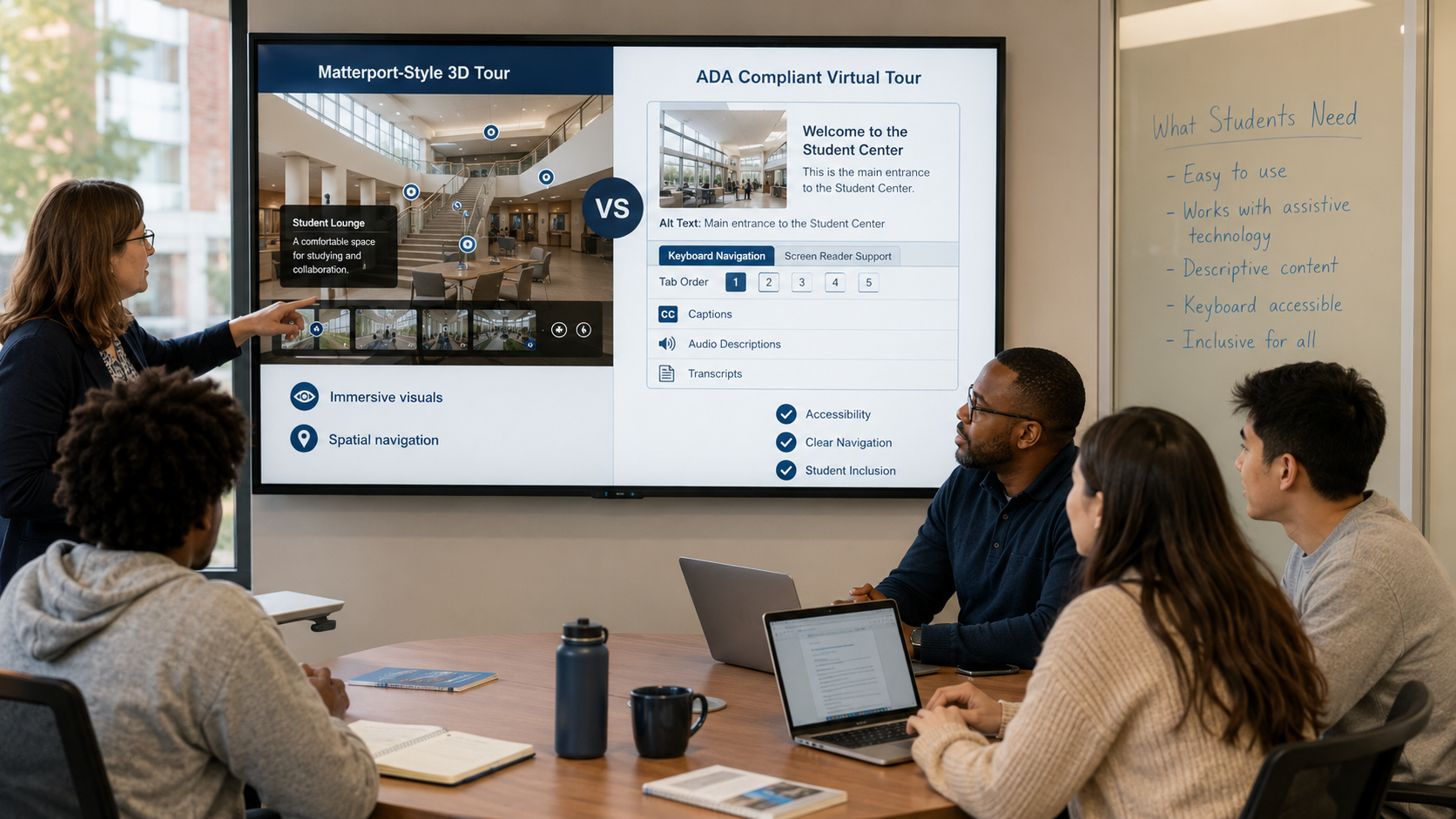








I have a virtual tour on my website and would like an audit.

I don't have a virtual tour yet, would love a demo to see how it works.

The most common accessibility problems in virtual campus tours include mouse-only navigation, unlabeled interactive controls, missing alternative text, inaccessible multimedia, poor keyboard focus, and limited screen reader compatibility. Addressing these barriers requires universities to evaluate the entire interactive experience against recognized accessibility standards such as WCAG 2.1 Level AA, rather than reviewing visual content alone.
Why Can Mouse-Only Navigation Create an Accessibility Barrier?
Many virtual tours are built around clicking, dragging, or selecting visual hotspots with a mouse. That can create problems for students who navigate digital content using a keyboard or assistive technology.
Important controls should be operable without requiring precise pointer movements. This includes menus, hotspots, maps, information panels, and other interactive elements.
Keyboard testing can reveal whether essential parts of a tour become unavailable when a mouse is not used.
What Happens When Interactive Controls Are Not Properly Labeled?
A button may be visually obvious while providing little information to a screen reader.
Generic or missing labels can make controls difficult to understand. A student may encounter an interactive element without knowing whether it opens a building, starts a video, changes floors, or performs another action.
Controls should have meaningful accessible names that clearly communicate their purpose.
Why Is Missing Alternative Text a Problem?
Virtual campus tours depend heavily on visual information.
Images may show residence halls, classrooms, laboratories, libraries, recreational spaces, or accessibility features. When meaningful visual content lacks an appropriate text alternative, some students may miss information available to sighted visitors.
Alternative text should communicate the purpose or relevant information of an image rather than attempting to describe every visual detail.
How Can Poor Screen Reader Compatibility Affect Campus Exploration?
Screen readers depend on properly structured digital content to communicate information and navigation options.
A visually functional virtual tour may still be difficult to use if menus, hotspots, headings, or controls cannot be interpreted correctly by assistive technology.
Universities should test interactive experiences with screen readers rather than assuming that accessibility on the surrounding webpage automatically makes the embedded tour accessible.
Why Does Keyboard Focus Matter in an Interactive Tour?
Keyboard users need to know which element is currently selected.
If the focus indicator is missing or difficult to see, navigation can become confusing. Students may lose track of their position while moving through menus, locations, or interactive controls.
Visible focus indicators and a logical focus order help users understand where they are and what action will occur next.
How Can Videos and Audio Create Accessibility Problems?
Virtual tours may include videos, narration, interviews, or other multimedia to provide additional campus information.
Audio without captions can exclude users who are deaf or hard of hearing. Video containing important visual information may also require appropriate descriptions, while audio content may need transcripts depending on how information is presented.
Captions, transcripts, and other accessible alternatives should be considered whenever multimedia communicates meaningful information.
Why Can Complex Navigation Make a Virtual Campus Tour Harder to Use?
Accessibility is not limited to technical compatibility. A tour can technically function while still being difficult to understand.
Inconsistent menus, unclear buttons, unexpected interactions, or complicated navigation paths can make campus exploration harder for users with cognitive, visual, or motor disabilities.
Navigation should remain predictable, clearly labeled, and consistent throughout the experience.
How Can Universities Identify Accessibility Problems?
Visual inspection alone cannot determine whether a virtual campus tour is accessible.
An accessibility review should examine areas such as:
- Keyboard-only operation
- Screen reader compatibility
- Alternative text
- Accessible names for controls
- Visible keyboard focus
- Captions and transcripts
- Navigation order
- Interactive maps and hotspots
Automated accessibility tools can identify certain technical issues, but manual testing is also important because interactive experiences often contain usability problems that automated checks cannot fully evaluate.
What Are the Most Common Misconceptions About Virtual Tour Accessibility?
One common misconception is that an accessible university website automatically makes an embedded virtual tour accessible. The tour itself may contain separate controls, navigation systems, multimedia, and interactive content that require evaluation.
Another mistake is treating accessibility as a checklist completed after development. Accessibility problems are generally easier to prevent when requirements are considered during planning, content creation, implementation, and testing.
A third misconception is that adding alternative text solves every accessibility problem. Alt text is important, but it does not replace keyboard accessibility, screen reader support, captions, clear controls, or logical navigation.
FAQs
A virtual campus tour can become inaccessible when essential content or controls cannot be perceived, understood, or operated by people using assistive technologies.
Yes, interactive functionality should be evaluated for keyboard access so essential features do not depend entirely on a mouse.
Meaningful visual content should have appropriate text alternatives when that information would otherwise be unavailable to users who cannot perceive the image.
Captions are important when prerecorded video contains spoken information that needs to be accessible to people who are deaf or hard of hearing.
No, automated testing can identify some accessibility problems, but manual evaluation is also necessary for interactive navigation, usability, and assistive technology compatibility.
Conclusion
Virtual campus tour accessibility depends on more than the quality of the visual experience. Keyboard barriers, inaccessible controls, missing text alternatives, multimedia issues, poor focus management, and screen reader incompatibility can prevent students from independently accessing campus information.
A thorough accessibility review should examine how the complete tour functions with different navigation methods and assistive technologies. Evaluating these areas against standards such as WCAG 2.1 Level AA can help universities identify barriers and provide more inclusive digital campus exploration.
I have a virtual tour on my website and would like an audit.
I don't have a virtual tour yet, would love a demo to see how it works.