







I have a virtual tour on my website and would like an audit.

I don't have a virtual tour yet, would love a demo to see how it works.

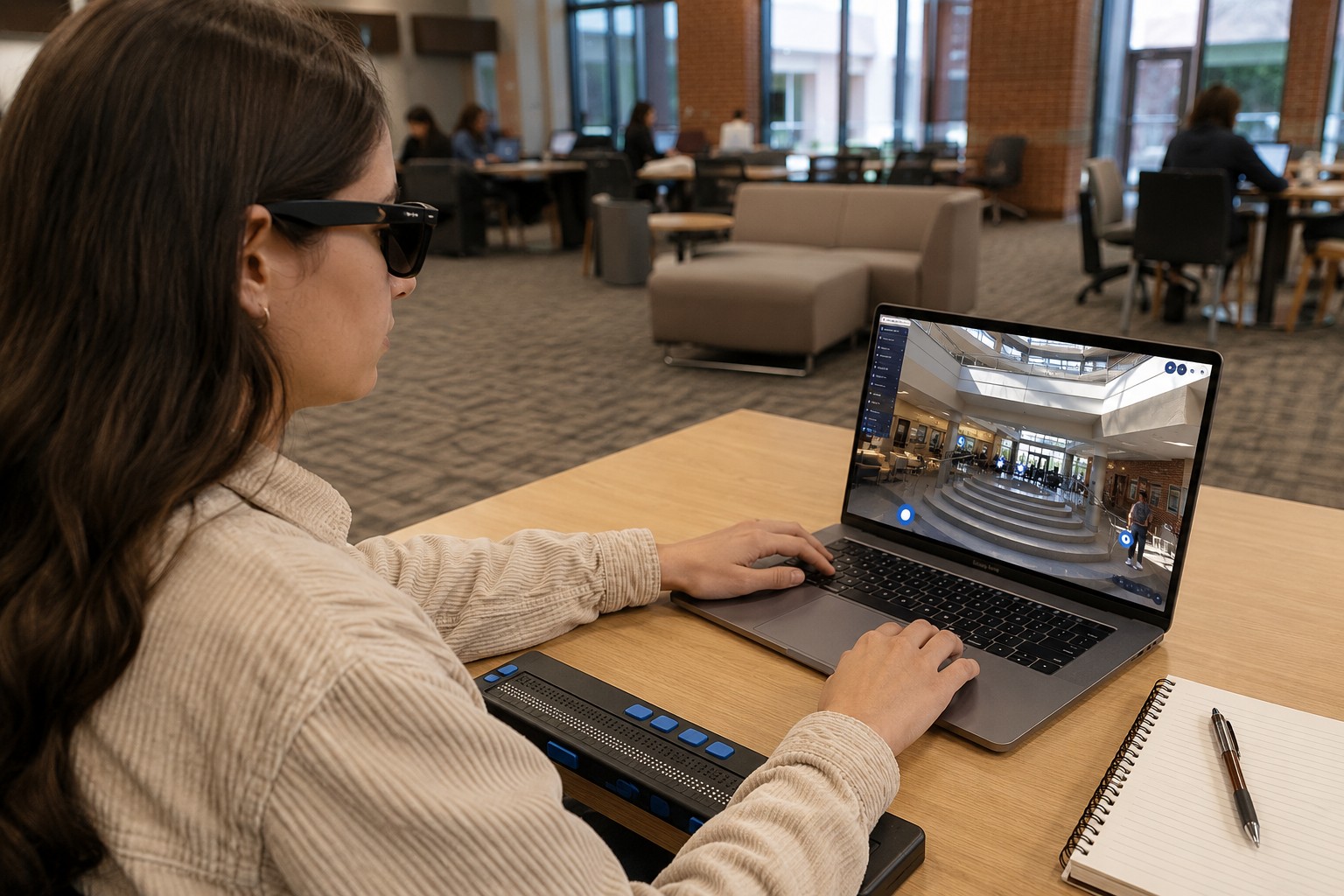
A virtual tour accessibility audit is a structured review that evaluates whether an online campus tour can be perceived, understood, navigated, and operated by people with disabilities. It examines elements such as keyboard navigation, screen-reader compatibility, captions, alternative text, color contrast, controls, multimedia, and interactive content against recognized accessibility requirements and guidelines.
What Does a Virtual Tour Accessibility Audit Examine?
Virtual campus tours combine several types of digital content that can create accessibility barriers when evaluated only as visual experiences.
An audit typically examines the complete user journey rather than reviewing individual images or pages in isolation. This includes navigation menus, 360-degree scenes, interactive hotspots, maps, videos, audio, forms, buttons, informational panels, and embedded content.
Common areas of evaluation include:
- Keyboard access to interactive controls
- Visible and logical keyboard focus
- Screen-reader labels for buttons and navigation
- Text alternatives for meaningful visual content
- Captions for prerecorded audio
- Audio description or equivalent alternatives where visual information is important
- Sufficient color contrast
- Proper heading and content structure
- Accessible forms and error messages
- Compatibility with different screen sizes and orientations
- Controls that do not depend entirely on dragging, hovering, or precise pointer movements
These areas closely reflect WCAG principles requiring digital content to be perceivable, operable, understandable, and robust. WCAG also specifically addresses text alternatives, multimedia captions, keyboard accessibility, navigation, and compatibility with assistive technologies.
Why Can Virtual Campus Tours Create Accessibility Problems?
The problem is that virtual tours are often highly interactive.
A conventional university webpage may primarily contain headings, paragraphs, images, and links. A virtual tour may add panoramic environments, directional arrows, floating information points, video overlays, interactive maps, pop-up panels, and movement-based controls.
Each additional interaction introduces another accessibility consideration.
For example, a hotspot that is easy to select with a mouse may not be reachable by keyboard. A building represented only through a panoramic photograph may provide little useful information to a screen-reader user. An automatically playing narration may create difficulties when playback controls are unclear or inaccessible.
Accessibility therefore needs to be evaluated at the functional level, not simply by checking whether the page containing the tour passes an automated website scan.
Why Do Universities Need Accessibility Audits for Virtual Tours?
Virtual tours increasingly function as part of a university’s digital information environment.
Prospective students may use them to explore residence halls, classrooms, laboratories, libraries, athletic facilities, accessibility features, or student spaces before deciding whether to visit or apply. When important information is presented through an inaccessible interaction, some users may receive a substantially different experience.
Accessibility also carries regulatory significance.
For public entities in the United States, the Department of Justice has established technical accessibility requirements for web content and mobile applications under Title II of the Americans with Disabilities Act. The rule uses WCAG 2.1 Level AA as its technical standard, although specific obligations and compliance dates depend on the entity and circumstances. Updated federal guidance lists compliance dates of April 26, 2027, for larger state and local government entities and April 26, 2028, for smaller entities and special district governments.
Universities should therefore treat virtual tours as part of the broader digital accessibility program rather than as isolated marketing content.
How Is a Virtual Tour Accessibility Audit Conducted?
The strongest approach combines automated and manual testing.
Automated accessibility scanners can identify certain technical issues efficiently, including some missing labels, structural problems, or color contrast failures. They cannot reliably determine whether every interaction is understandable or usable.
Manual testing should therefore examine the tour using keyboard-only navigation and assistive technologies such as screen readers. Multimedia should be reviewed separately for caption accuracy, meaningful visual information, transcripts, and audio alternatives.
The tour should also be tested across realistic interaction paths. A reviewer might attempt to enter the tour, move between campus locations, activate hotspots, watch media, open informational panels, complete forms, and exit interactive elements without using a mouse.
Findings should then be documented by severity, affected component, relevant accessibility requirement, and recommended remediation.
What Accessibility Standards Should Universities Consider?
WCAG provides the primary technical framework used for web accessibility evaluation.
W3C currently recommends WCAG 2.2 for organizations developing or updating accessibility policies. WCAG 2.2 builds on WCAG 2.1 and adds criteria addressing areas including focus visibility, dragging movements, and minimum target sizes, which can be particularly relevant to interactive interfaces.
An audit may therefore consider WCAG 2.2 even where a particular legal requirement currently references WCAG 2.1.
Universities may use several accessibility-testing categories together, including automated scanning, manual keyboard testing, screen-reader testing, multimedia review, code inspection, and usability testing involving people with disabilities.
What Do Universities Commonly Get Wrong About Accessibility Audits?
A common misconception is that passing an automated accessibility scan means a virtual tour is accessible.
Automated tools are useful, but many virtual-tour problems require human interaction to discover. Logical focus order, confusing hotspot labels, keyboard traps, inaccessible panoramic navigation, unclear control behavior, and inadequate descriptions may not be identified reliably through automation alone.
Another mistake is auditing only the webpage surrounding the tour. Embedded tour interfaces, third-party components, media players, maps, and interactive modules also need evaluation.
Accessibility should also not be treated as a one-time certification. Changes to tour content, software components, multimedia, navigation, or embedded tools can introduce new barriers.
Regular review is therefore more effective than relying on the results of a single historical audit.
How Often Should a University Audit Its Virtual Tour?
A university should review accessibility before launching a new virtual tour and after significant platform, navigation, content, or multimedia changes.
Periodic audits can also identify problems introduced through routine updates. Testing frequency should reflect how often the tour changes and how important it is within recruitment, admissions, orientation, or campus information processes.
Maintaining records of identified issues and remediation work can also help accessibility teams track recurring problems across digital experiences.
FAQs
A virtual tour accessibility audit identifies barriers that may prevent people with disabilities from effectively navigating, perceiving, understanding, or interacting with an online tour.
No, automated software can detect some technical issues, but keyboard interaction, screen-reader behavior, multimedia accessibility, and complex interactive experiences usually require manual testing.
WCAG can be applied to web-based interactive content, including navigation, multimedia, controls, maps, hotspots, and other components used within virtual tours.
Prerecorded synchronized media containing meaningful audio generally requires captions under WCAG accessibility criteria.
Yes, third-party or embedded content should be evaluated because accessibility barriers within those components can still affect the overall user experience.
I have a virtual tour on my website and would like an audit.
I don't have a virtual tour yet, would love a demo to see how it works.