







I have a virtual tour on my website and would like an audit.

I don't have a virtual tour yet, would love a demo to see how it works.

Universities should identify accessibility barriers, document affected features, and work with third-party providers to correct problems when a virtual campus tour is not ADA accessible. Public universities should evaluate applicable ADA Title II requirements and WCAG 2.1 Level AA standards while ensuring students with disabilities can access essential campus information. When immediate remediation is unavailable, institutions should provide effective accessible alternatives while pursuing a permanent solution.
Why Are Third-Party Virtual Tours an Accessibility Concern for Universities?
Many universities use external technology providers to create, host, or manage interactive campus experiences.
These platforms may include panoramic imagery, navigation hotspots, multimedia, and interactive maps. However, some features may not support keyboard navigation, screen readers, or other assistive technologies.
When accessibility barriers prevent students with disabilities from exploring campus information, universities need to evaluate the impact and determine appropriate corrective measures.
Using an external provider does not automatically eliminate an institution’s accessibility responsibilities.
Are Universities Responsible for Accessibility Issues in Third-Party Virtual Tours?
Public universities covered by ADA Title II generally remain responsible for ensuring that their services, programs, and activities are accessible, including when delivered through contractual arrangements.
The Department of Justice’s Title II web accessibility rule establishes WCAG 2.1 Level AA as the technical standard for covered web content and mobile applications, subject to specified exceptions and limitations.
A virtual campus tour provided through a university website may therefore fall within applicable accessibility obligations.
Institutions should assess the tour’s role, the content it provides, and whether students with disabilities can obtain equivalent access to important information.
How Can Universities Identify Accessibility Problems in Third-Party Platforms?
Accessibility barriers are not always visible during ordinary website testing.
A virtual tour may appear functional while containing controls that cannot be operated with a keyboard or understood by screen readers.
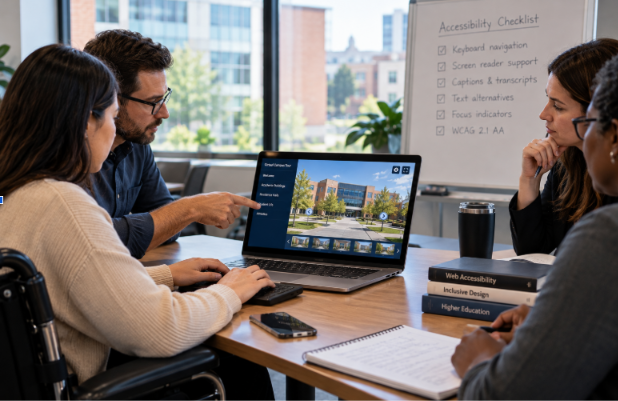
Universities should evaluate common problem areas, including:
- Keyboard navigation and focus order
- Screen reader compatibility
- Interactive hotspot labels
- Text alternatives for meaningful imagery
- Captions and transcripts
- Color contrast
- Accessible campus maps
- Mobile accessibility
Automated testing can identify some technical issues, but manual evaluation is necessary for complex interactions.
Testing should focus on whether students can complete essential tasks, such as finding buildings, accessing facility information, and moving between locations.
What Should Universities Request From Third-Party Virtual Tour Providers?
Universities may not have direct access to the underlying technology needed to correct accessibility problems.
In these situations, providers should receive specific information about identified barriers.
Useful documentation includes affected pages, inaccessible features, steps to reproduce problems, and relevant accessibility criteria.
Universities can request an accessibility conformance report, testing documentation, and a remediation plan.
A remediation plan should identify the issues being addressed, responsible parties, expected completion dates, and methods for verifying corrections.
Provider statements should be evaluated alongside practical accessibility testing rather than accepted as sufficient evidence on their own.
What Should Universities Do While Accessibility Issues Are Being Fixed?
Some accessibility problems cannot be corrected immediately, particularly when changes require platform-level development.
Universities should consider interim measures that preserve access to essential campus information.
Depending on the barrier, these measures may include accessible building descriptions, structured location directories, text-based campus information, or alternative ways to obtain equivalent information.
However, providing an alternative does not automatically resolve every compliance concern.
Interim arrangements should offer effective access while the underlying accessibility barriers are addressed.
Can Universities Fix Accessibility Problems Without Changing Platforms?
Some barriers may be corrected through content updates or configuration changes.
For example, a university may be able to improve location descriptions, add captions, or revise certain labels without replacing the underlying platform.
Other problems may involve inaccessible navigation controls, incompatible interactive components, or limitations within the platform’s architecture.
These issues may require changes from the technology provider.
Universities should distinguish between content-level problems and platform-level limitations before determining an appropriate remediation approach.
When Should Universities Consider Replacing a Virtual Tour Platform?
Repeated accessibility problems may indicate limitations that cannot be resolved through routine updates.
A university may need to reconsider its platform when essential functionality remains inaccessible, remediation commitments are repeatedly missed, or the provider cannot demonstrate meaningful progress.
Before making a decision, institutions should assess the severity of outstanding barriers, available alternatives, and the feasibility of correction.
Any replacement platform should undergo accessibility evaluation before implementation to avoid introducing similar problems.
How Can Universities Prevent Third-Party Accessibility Issues in the Future?
Accessibility requirements are easier to address before a platform is adopted than after significant content has been published.
Universities should include accessibility expectations in procurement and vendor evaluation processes.
These expectations may cover WCAG conformance, assistive technology testing, accessibility documentation, remediation responsibilities, and support for future updates.
Institutions should also establish procedures for reviewing accessibility when providers introduce new features or modify existing functionality.
Ongoing oversight helps prevent previously corrected barriers from returning.
What Are Common Mistakes When Managing Third-Party Virtual Tour Accessibility?
Assuming the provider is solely responsible for compliance.
Universities may retain accessibility obligations even when external companies manage the technology.
Relying entirely on vendor accessibility claims.
A statement of compliance does not replace independent evaluation of actual functionality.
Treating automated scans as complete accessibility audits.
Automated tools cannot reliably evaluate every screen reader, keyboard, or interactive navigation issue.
Assuming an alternative format always resolves the problem.
Alternative access must be evaluated for effectiveness and does not necessarily eliminate the need to remediate inaccessible digital content.
Failing to verify completed fixes.
Corrected features should be retested to confirm that accessibility barriers have actually been removed.
FAQs
Public universities may remain responsible for accessibility obligations under ADA Title II even when digital services are provided by external vendors.
The answer depends on the applicable legal requirements, the barriers involved, and any relevant exceptions or limitations.
Universities should request accessibility documentation, testing results, identified limitations, and plans for correcting barriers.
An accessible alternative may support effective access, but it does not automatically satisfy every applicable accessibility requirement.
Yes, retesting helps verify that reported barriers have been resolved without introducing new accessibility problems.
Conclusion
Third-party virtual tour accessibility requires universities to evaluate both their own responsibilities and the technical capabilities of external providers.
Identifying barriers, documenting problems, requesting remediation, and maintaining effective access to campus information are important steps when accessibility issues arise.
By combining vendor accountability with practical testing and ongoing oversight, universities can reduce accessibility barriers and better support students with disabilities throughout the digital campus exploration experience.
I have a virtual tour on my website and would like an audit.
I don't have a virtual tour yet, would love a demo to see how it works.