







I have a virtual tour on my website and would like an audit.

I don't have a virtual tour yet, would love a demo to see how it works.

Virtual walkthroughs offer a more immersive and interactive experience than traditional campus videos. Unlike videos, which are static and pre-recorded, virtual walkthroughs let users explore the campus in real-time, giving them control over what to see and how they navigate the space. This provides a more accurate, engaging, and comprehensive way to experience a campus remotely.
Why Virtual Walkthroughs Are More Interactive
Traditional campus videos are usually pre-recorded and show a limited perspective of the campus. Viewers have no control over what they see or how they move through the space. They only get to see what the video editor has chosen to show.
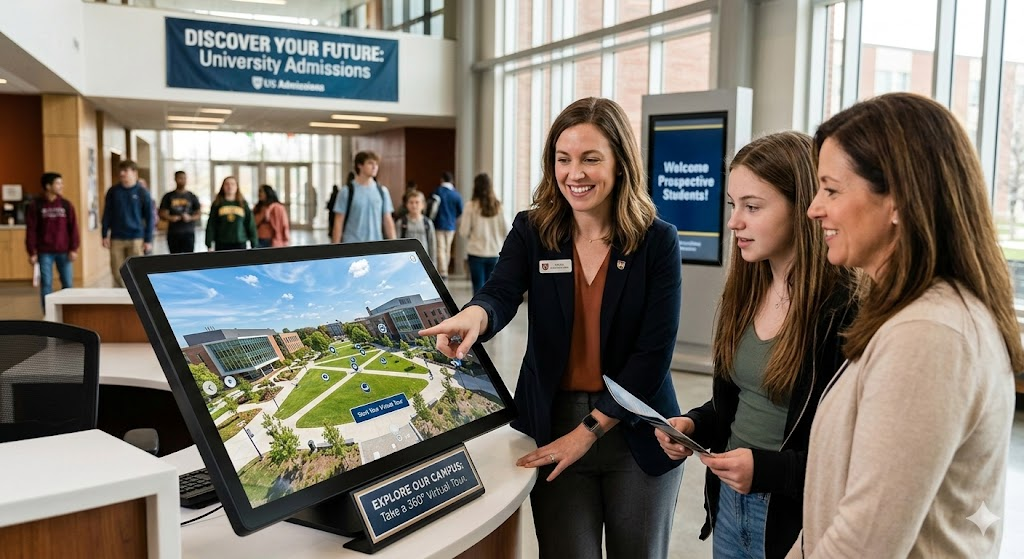
On the other hand, virtual walkthroughs allow users to explore the campus at their own pace, zoom in on areas that interest them, and revisit spaces as needed. This interactive experience creates a sense of real-time exploration that videos simply cannot provide.
How Virtual Walkthroughs Offer Better Spatial Understanding
Traditional campus videos often fail to give a clear understanding of the layout and flow of a campus. They can make rooms and buildings appear disconnected or distant from one another, leaving the viewer with an incomplete view of how spaces interact.
Virtual walkthroughs solve this problem by allowing users to navigate the campus just like they would in real life. This spatial continuity helps visitors understand the relationships between different areas and get a better sense of the campus as a whole.
Why Traditional Campus Videos Fall Short
Campus videos are usually well-polished, but they have their limitations:
- They are passive experiences—viewers can’t choose what to see or where to go.
- They often show disconnected segments of campus life, leading to confusion about the flow of the campus.
- They can’t replicate the feeling of actually walking through space.
Virtual walkthroughs, however, let visitors interact with the space in a more meaningful way, exploring different areas and visualizing how they would move between buildings or spaces.
How Virtual Walkthroughs Build Trust
When it comes to decision-making, trust is key. Traditional campus videos are controlled by the institution, which means viewers only see what the school chooses to show. This creates uncertainty and can leave prospective students questioning how accurate the representation is.
Virtual walkthroughs give users control, letting them explore campus spaces on their own. By offering a more honest and transparent view of the campus, virtual walkthroughs help build trust and confidence in prospective students and their families.
How Virtual Walkthroughs Help Students Compare Campuses
When considering multiple universities, prospective students need to be able to compare campuses effectively. Traditional videos can make this difficult because they present limited or inconsistent views of the same types of spaces.
Virtual walkthroughs standardize the experience by offering the same format for every institution. This allows students to compare layouts, spaces, and campus features side by side, making the decision-making process clearer and more straightforward.
Common Misunderstandings About Virtual Walkthroughs
Virtual walkthroughs replace the need for in-person visits
While virtual tours provide an immersive experience, they cannot fully replace the feeling of being on campus. They do, however, help students decide whether an in-person visit is necessary, saving time and effort for both parties.
Photos and videos are enough to evaluate a campus
Static photos and videos show limited perspectives and don’t provide a sense of how campus spaces fit together. Virtual walkthroughs offer a continuous, realistic experience that’s more helpful for decision-making.
Virtual walkthroughs are only useful for large campuses
Smaller campuses also benefit from virtual tours. Virtual walkthroughs give prospective students a clear, cohesive understanding of even small campuses, helping them visualize the space and make confident decisions.
FAQs
Virtual walkthroughs allow users to control their exploration, while videos only show what is captured by the camera.
Yes, they provide a comprehensive view of the campus, helping prospective students decide whether an in-person visit is needed.
Yes, virtual walkthroughs provide a detailed and organized view of even small campuses, helping users understand the layout clearly.
Yes, they let users explore campus spaces naturally, offering a more accurate experience than static photos or videos.
Yes, most virtual tours are intuitive and designed to be user-friendly, allowing smooth navigation across devices.
Conclusion
While traditional campus videos have their place in promoting educational institutions, virtual walkthroughs provide a more interactive, realistic, and comprehensive experience for prospective students. They allow users to explore campus spaces at their own pace, get a better understanding of layout, and make informed decisions with confidence.
As digital engagement continues to grow in higher education, virtual walkthroughs will become an increasingly valuable tool for institutions to connect with prospective students and families, offering a more immersive and trustworthy alternative to static photos and videos.
I have a virtual tour on my website and would like an audit.
I don't have a virtual tour yet, would love a demo to see how it works.