







I have a virtual tour on my website and would like an audit.

I don't have a virtual tour yet, would love a demo to see how it works.

Choosing a university is difficult when the student can physically stand on campus, walk through the library, visit residence halls, and experience the atmosphere firsthand. For international students, that decision often becomes even more complex. Distance, travel cost, visa limitations, time zone differences, and family involvement can all make an in-person campus visit unrealistic.
That creates a real challenge for universities. How do you help a student thousands of miles away understand not only what your campus looks like, but how it works, how spaces connect, and whether they can imagine themselves studying there?
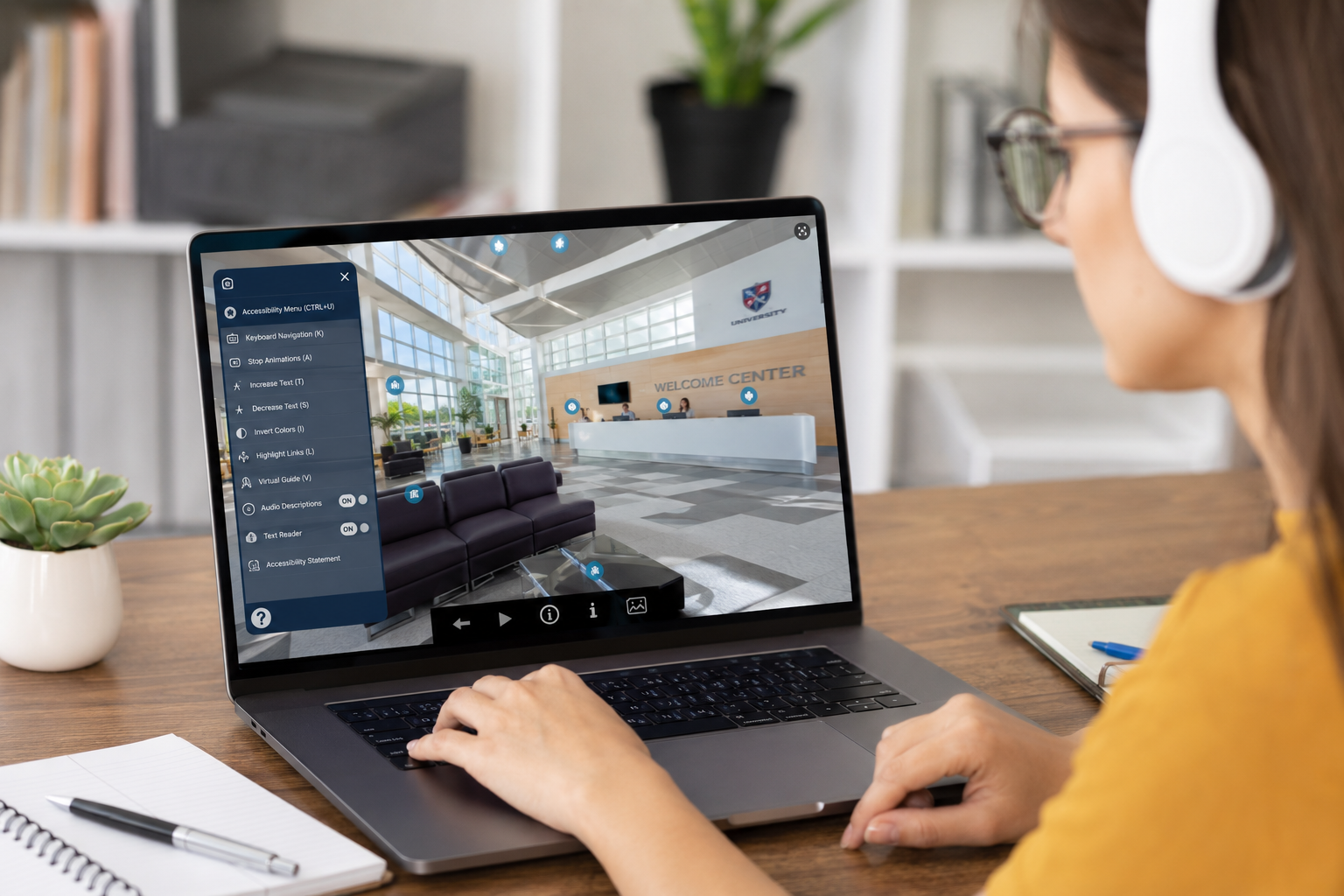
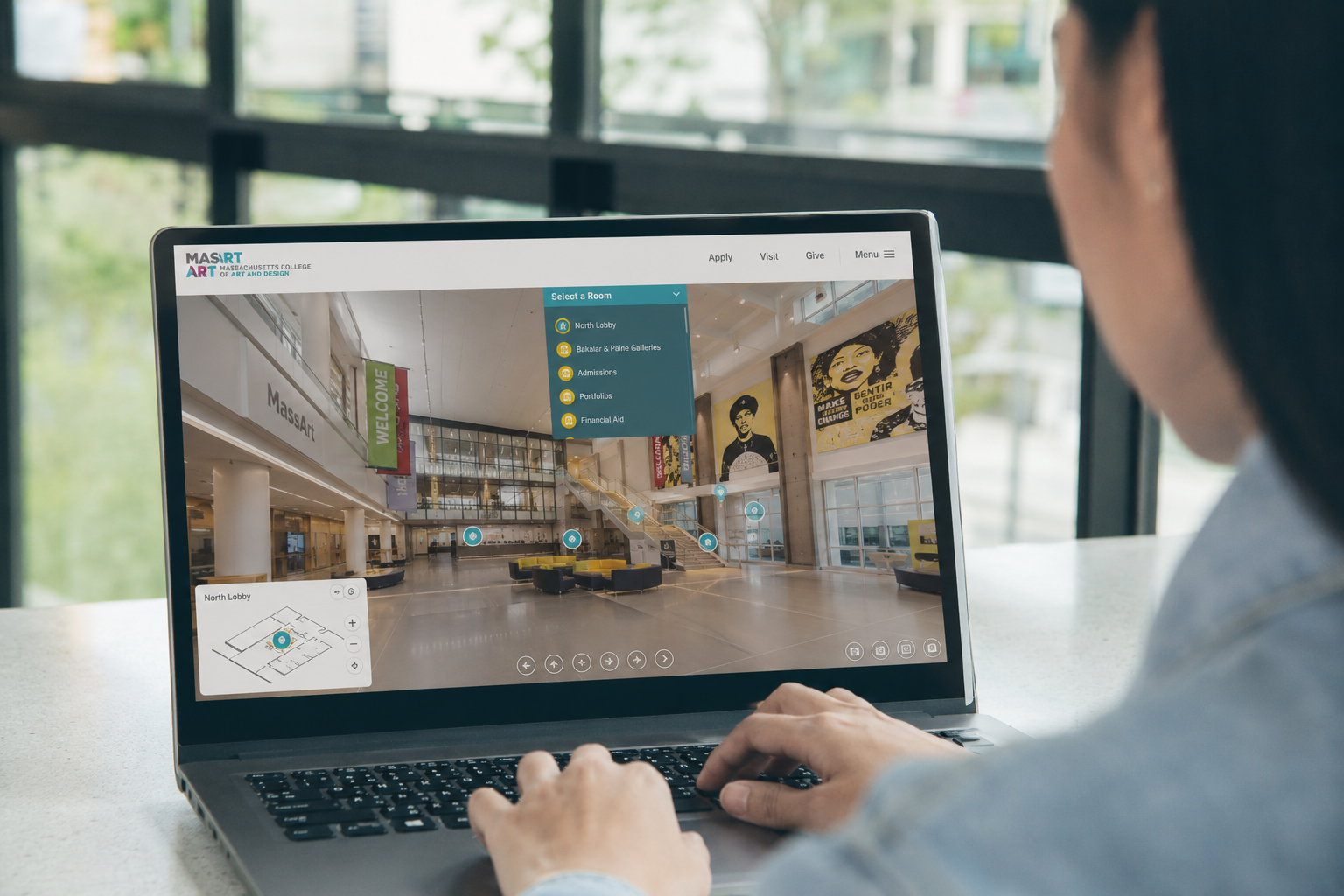
This is where virtual campus tours become valuable. A strong virtual tour does more than display attractive images. It gives international students a structured, interactive way to explore academic buildings, housing, libraries, student spaces, and outdoor areas from wherever they are. It turns the campus from an abstract idea into a navigable environment.
For universities competing for global applicants, this matters because international recruitment is not only about visibility. It is about clarity, trust, accessibility, and helping students make confident decisions before they ever arrive.
Key Takeaways
- Virtual campus tours help international students explore university spaces without needing to travel.
- Interactive navigation improves spatial understanding better than isolated photos or linear videos.
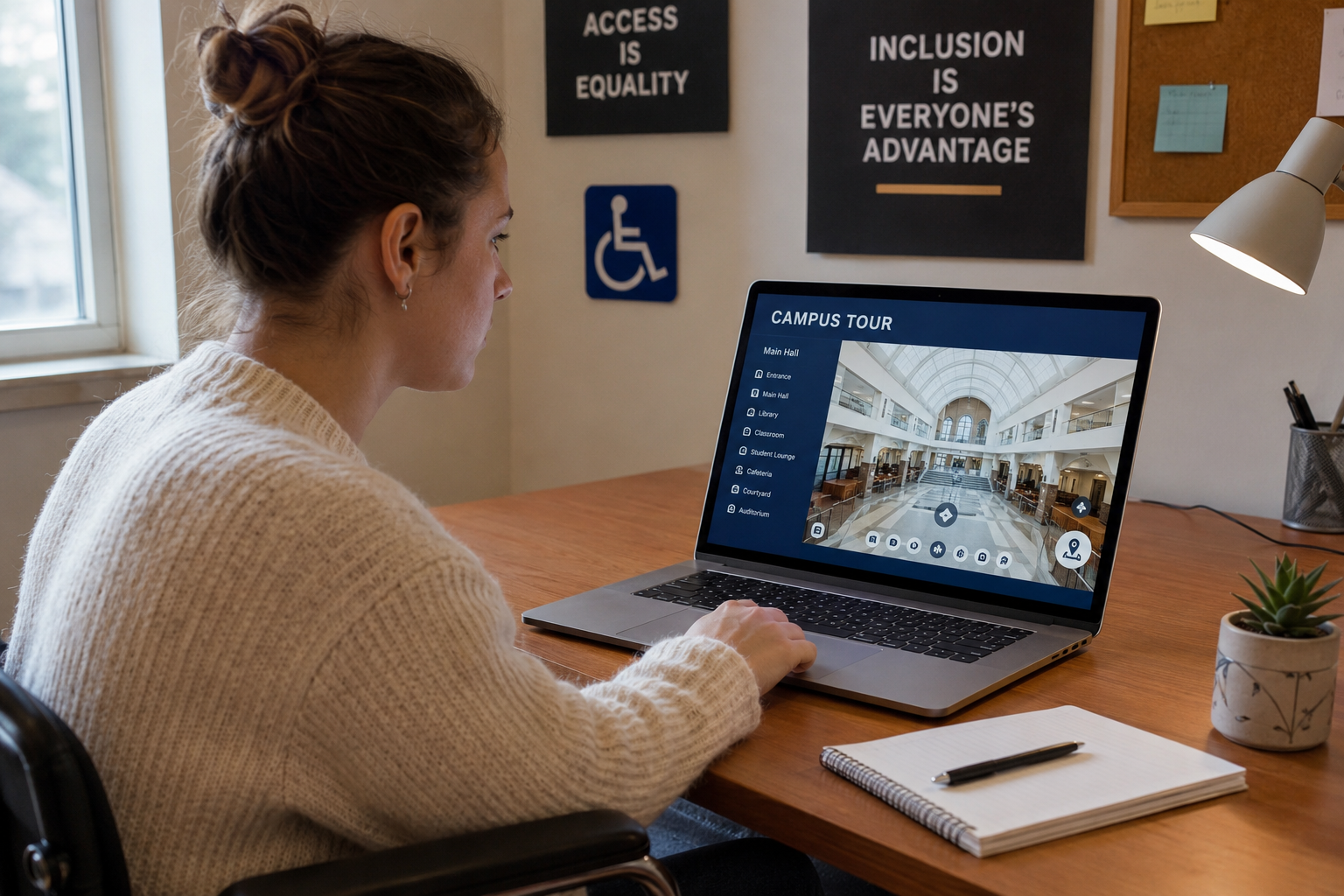
- Virtual tours support accessibility by giving remote students equal access to campus information.
- Universities use virtual tours to reduce uncertainty, build trust, and support informed admissions decisions.
- For international audiences, the strongest tours communicate how the campus functions, not just how it looks.
Why This Topic Matters?
International students often evaluate universities from a distance. They may compare several institutions across different countries, each with different admissions requirements, tuition structures, housing options, and campus environments. In that process, the physical campus is still important, but access to it is unequal.
A local student may attend an open house. An out-of-state student may schedule a weekend visit. An international student may only have a website, brochure, social media page, or short video to rely on.
That gap affects understanding.
Campuses are spatial environments. Students do not experience them as disconnected buildings. They experience them through movement: walking from residence halls to classrooms, finding the library after lectures, locating student services, moving through dining areas, and understanding where social and academic life happens. Static content rarely communicates this clearly.
Virtual tours matter because they give remote students a more complete way to evaluate place. They support accessibility by removing the requirement of physical travel. They support inclusion by allowing students and families in different countries to explore the same spaces as domestic visitors. They support clarity by showing how facilities, pathways, and buildings relate to one another.
For universities, this is not just a digital marketing tactic. It is a communication tool that helps international students understand the environment they are being asked to choose.
The International Student Decision Is Built on Trust
Distance Creates Information Gaps
International students are often making one of the largest decisions of their lives without visiting the campus in person. They may be choosing where they will live, study, build friendships, and begin a professional path. Their families may also be involved in the decision, especially when the student is relocating across borders.
In this context, uncertainty is natural. Students may ask:
Will the campus feel welcoming?
Are the facilities modern and accessible?
How far are academic buildings from housing?
What does the library actually look like?
Where do students gather outside class?
Does the campus feel easy to navigate?
A standard admissions page can answer some of these questions with text. Photos can show selected spaces. Videos can tell a polished story. But none of these formats fully allow students to examine the environment for themselves.
A virtual campus tour gives the student more control. They can enter a space, move through it, pause, revisit it, and explore areas that matter to their own priorities. That sense of control is important because trust increases when students can investigate rather than simply receive information.
Transparency Reduces Anxiety
For international students, unknowns can feel larger because the cost of being wrong is higher. A student moving from another country cannot easily “drop by” to confirm whether a campus feels right. They need confidence before applying, enrolling, or making travel plans.
Virtual tours reduce that anxiety by making the environment more visible. When students can explore classrooms, housing, libraries, student centers, and shared spaces, they are no longer relying only on claims. They can form their own impression.
This transparency helps universities communicate honestly. A virtual tour does not need to overstate the campus. Its value comes from showing spaces clearly and helping students understand what daily life may look like.
Virtual Campus Tours Improve Spatial Understanding
Students Need to Understand Flow, Not Just Facilities
A common mistake in campus communication is treating buildings as separate selling points. A university may highlight a lab, library, residence hall, or recreation center, but students also need to understand how those places connect.
For international students, spatial clarity is especially important because they may be unfamiliar with the country, city, campus scale, or local transportation norms. A virtual tour can help them understand the practical experience of moving through the campus.
For example, a student can see how close academic buildings are to residence areas, whether pathways feel intuitive, how common spaces are positioned, and how the campus is organized. This creates a mental map before arrival.
That mental map matters. It helps students imagine routines: leaving a dorm, walking to class, studying in the library, meeting friends, visiting administrative offices, or attending campus events.
Interactive Navigation Builds Memory
When a student actively chooses where to go inside a virtual tour, they process the campus differently than they would while watching a video. Interaction creates involvement. The user is not just observing a sequence; they are making decisions.
This is why virtual tours are useful for international recruitment. A student in another country can explore the campus repeatedly, perhaps first with parents, then alone, then again while comparing institutions. Each visit builds familiarity.
The more familiar a campus feels, the less intimidating relocation becomes.
How Virtual Tours Support International Admissions
They Extend Campus Access Across Time Zones
Admissions teams often work with students across many regions. Live information sessions, calls, and guided virtual events can be useful, but they require scheduling. International students may be in time zones that make live attendance difficult.
A virtual campus tour solves part of this access problem because it is available on demand. Students can explore when it suits them. Parents or guardians can view the campus separately. Counselors, agents, or school advisors can also use the tour to better understand the institution.
This creates a more flexible admissions experience. Instead of waiting for a scheduled event, the student can begin building familiarity immediately.
They Help Students Qualify Their Own Interest
International admissions teams often receive inquiries from students at different levels of readiness. Some are seriously evaluating enrollment. Others are still trying to understand whether the university fits their needs.
A virtual tour helps students self-educate before reaching out. They can explore key spaces, understand the campus layout, and decide whether they want to take the next step. This makes later conversations more informed.
A student who has already explored housing, academic buildings, and student life areas may ask better questions during admissions calls. Instead of asking only general questions, they can ask about specific spaces, programs, accessibility needs, or campus routines.
This benefits both the student and the institution. The student feels more prepared, and admissions teams spend time addressing deeper concerns.
Virtual Tours vs Photos for International Students
Photos are useful, but they are selective. A photograph captures one angle, one moment, and one frame. It can show that a library is attractive, but it does not show how large the space feels, where study areas are located, how users move through the building, or how the library connects to the rest of campus.
For international students, this limitation matters because they are often trying to make sense of an unfamiliar environment. A set of polished images may create interest, but it may not create understanding.
Virtual tours provide continuity. Students can move from one point to another and see the relationship between spaces. A classroom is no longer just an image; it becomes part of a larger academic environment. A residence hall is not just a room; it connects to hallways, common areas, exterior paths, and nearby facilities.
The impact is different. Photos show highlights. Virtual tours support interpretation.
For a broader discussion of this topic, universities can connect this article to the pillar blog: [Benefits of Virtual Tours for Schools, Colleges, and Universities.
Virtual Tours vs Videos for International Students
Videos can tell a strong story, but they control the entire experience. The viewer follows the path chosen by the institution. The pace, sequence, and focus are fixed.
That can be helpful for emotional storytelling, but it can limit practical evaluation.
An international student may want to spend extra time looking at residence halls, accessibility routes, labs, or student support spaces. In a video, they can pause or replay, but they cannot choose a new path. They cannot inspect the environment in the same way.
Virtual campus tours give users more agency. They can move at their own pace, revisit spaces, and prioritize what matters to them. This changes the experience from passive viewing to active exploration.
The difference affects decision-making. A video may help a student feel inspired. A virtual tour helps them understand whether the campus fits their needs.
Supporting Families in the Decision Process
International students rarely make decisions alone. Parents, guardians, sponsors, or extended family members may want to understand where the student will live and study.
Virtual tours make the campus easier to share. A student can send the tour link to family members in another city or country. Families can explore housing, academic areas, and public spaces together, even if they are not physically in the same room.
This shared exploration can reduce concern. Families can see the environment more clearly, ask better questions, and feel more included in the process.
For universities, this is important because family confidence can influence whether a student moves forward. A virtual tour gives families a more concrete view of the institution than text or images alone.
Making Campus Culture More Understandable
Campus culture is difficult to communicate remotely. It is not only found in slogans, student testimonials, or event photos. It is also expressed through spaces: where students gather, how open common areas feel, how classrooms are arranged, how libraries support study, and how outdoor areas encourage movement and connection.
A virtual tour cannot replace the full lived experience of being on campus, but it can give international students useful signals.
They can see whether the campus feels active, open, formal, modern, traditional, compact, spread out, urban, or quiet. They can understand how different spaces contribute to the student experience.
This matters because international students are not only choosing an academic program. They are choosing an environment where they must adapt, belong, and build a routine.
What Makes a Virtual Campus Tour Useful for International Audiences?
A useful virtual campus tour should not feel like a random collection of panoramic scenes. It should be structured around how students actually evaluate a campus.
That means including important spaces such as academic buildings, classrooms, libraries, residence areas, dining spaces, outdoor areas, student service points, and major pathways. It also means making navigation intuitive, so students do not feel lost.
The best tours help users answer practical questions:
Where would I study?
Where would I live?
How would I move through campus?
What resources are available?
Does this environment feel understandable and accessible?
Interactive elements such as navigation points, contextual labels, maps, and multimedia can help students interpret what they are seeing. The goal is not to overwhelm the user with features. The goal is to make the campus easier to understand.
FAQs
No. Virtual campus tours do not replace the value of physically visiting a campus. They help students explore earlier, especially when travel is difficult. For international students, they often act as a first-stage evaluation tool before an application, deposit, or future visit.
No. They are valuable for any student who cannot visit immediately, including out-of-state applicants, working students, parents, remote learners, and students with mobility limitations. International students are a major audience because distance creates a stronger access barrier.
Universities should focus on spaces that shape student decisions: classrooms, labs, libraries, housing, dining areas, student centers, outdoor gathering spaces, and key routes across campus. The tour should help users understand both individual facilities and how the campus functions as a connected environment.
They help admissions teams provide consistent, on-demand campus access to students across regions and time zones. They also allow students to explore before speaking with admissions staff, which can lead to more informed questions and clearer decision-making.
They serve different purposes. Videos are useful for storytelling, while virtual tours are stronger for exploration and spatial understanding. For international students comparing campuses remotely, interactive control often provides more practical clarity than a fixed video sequence.
Final Thoughts
Virtual campus tours help universities reach international students by making distance less limiting. They allow students to explore real spaces, understand campus layout, involve their families, and build confidence before making major decisions.
Their value is not simply that they are digital. Their value is that they make physical environments easier to understand from anywhere.
For universities, this supports a more accessible and transparent admissions experience. For international students, it creates a clearer path from curiosity to confidence. They can see where they might study, where they might live, how they might move through campus, and whether the institution feels like a place they can belong.
As higher education continues to serve more global audiences, virtual campus tours will become less of an optional enhancement and more of a practical expectation. Institutions that communicate their spaces clearly will be better positioned to build trust with students who may be making life-changing decisions from thousands of miles away.
I have a virtual tour on my website and would like an audit.
I don't have a virtual tour yet, would love a demo to see how it works.